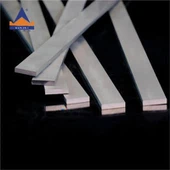
Tungsten steel: The finished product contains about 18% tungsten alloy steel. Tungsten steel belongs to hard alloy, also known as tungsten-titanium alloy. The hardness is Vickers 10K, second only to diamond. Because of this, tungsten steel products (tungsten steel watches are common) are not easy to be worn. It is often used on lathe tools, impact drill bits, glass cutter heads, and tile cutters. It is strong and not afraid of annealing, but brittle.
Cemented carbide: belongs to the field of powder metallurgy. Cemented carbide, also known as cermet, is mainly composed of metal carbides (WC, TaC, TiC, NbC, etc.) or metal oxides (such as Al2O3, ZrO2, etc.), adding an appropriate amount of metal powder (Co, Cr, Mo, Ni, Fe, etc.) made by powder metallurgy method, ceramics with certain characteristics of metal. Cobalt (Co) is used to play a bonding effect in the alloy, that is, during the sintering process, it can surround and tightly bond the tungsten carbide (WC) powder together, and after cooling, it becomes hard Alloy. (Effect equivalent to cement in concrete). Common content: 3%--30% Tungsten carbide (WC) is the main component that determines some metal properties of this cemented carbide or cermet, accounting for 70%--97% (weight ratio) of the total composition. It is widely used for wear resistance , High temperature resistance, corrosion resistance, parts or knives with harsh working environment, on the cutter head of the tool.
Tungsten steel belongs to cemented carbide, but cemented carbide is not necessarily tungsten steel. Now customers in Taiwan and Southeast Asian countries like to use the word tungsten steel. If you talk to them carefully, you will find that most of them still refer to hard alloys. alloy.
The difference between tungsten steel and cemented carbide is that it is also called high-speed steel or tool steel. Usually 15-25%; while cemented carbide is sintered with tungsten carbide as the main body and cobalt or other bonding metals by powder metallurgy technology, and its tungsten content is usually above 80%. Simply put, all things with a hardness exceeding HRC65 can be called cemented carbide as long as they are alloys. Tungsten steel is just a kind of cemented carbide with a hardness between HRC85 and 92, which is often used to make knives.
The difference between cemented carbide and tungsten steel
Mar 18, 2023
Tinggalkan pesan
Anda Mungkin Juga Menyukai